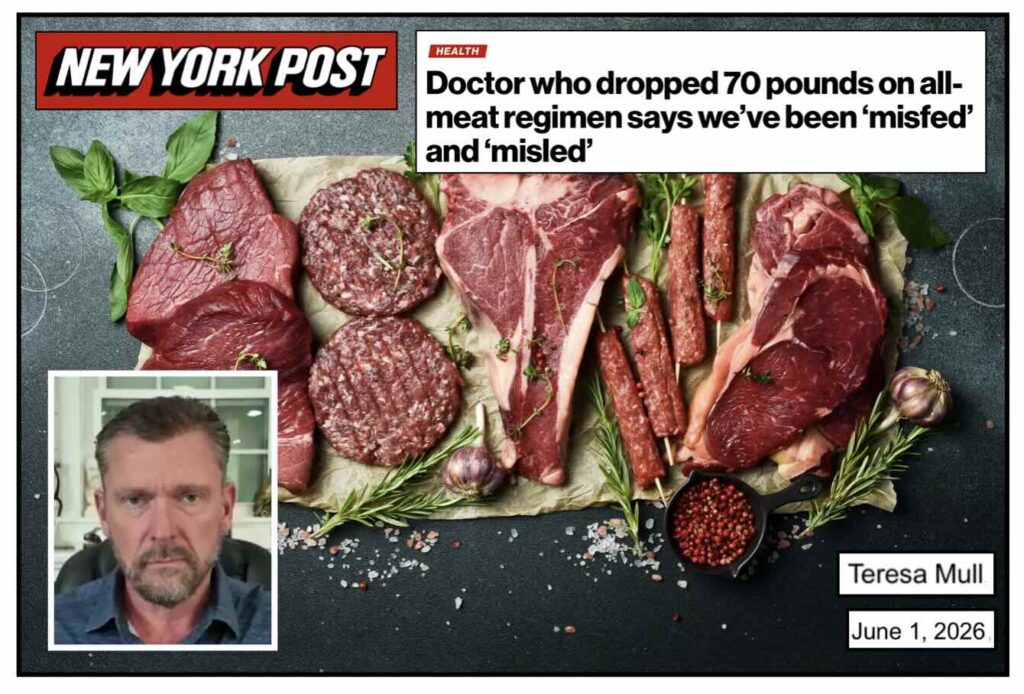
The New York Post published a 750 word article promoting the claims of carnivore diet influencer Dr. Ken Berry, a physician who says he lost 70 pounds by living on “beef, butter, bacon and eggs” and believes Americans have been “misled and misfed” about nutrition.
The article devotes its first eleven paragraphs almost entirely to Berry’s personal success story and keynote appearance at Meatstock, a convention for followers of carnivore and ketogenic diets. The Post reports that Berry reversed prediabetes, lost weight, and has heard countless testimonials from people who claim to have improved their health on all-meat diets.
Only in the second half of the article are readers exposed to concerns from mainstream nutrition experts, who warn that carnivore diets may increase the risk of nutritional deficiencies, digestive problems, kidney stones, elevated cholesterol and colon cancer.
The reporting raises several concerns. It presents Berry as a credible medical authority without adequately examining his financial stake in the carnivore movement. Beyond his medical practice, Berry has built a large online business around his dietary philosophy — selling books, memberships, educational programs and merchandise while promoting products and brands to his millions of followers. Yet readers are given little indication that the physician being presented as an independent expert has a substantial professional and financial interest in the continued growth of the carnivore lifestyle.
The article also allows extraordinary claims to go largely unchallenged. Berry argues that whole grains are “almost uniformly inflammatory;” that legumes spike insulin in harmful ways; and that concerns about bacon, red meat and cancer are overstated. These assertions conflict with a substantial body of research linking higher consumption of whole grains, legumes, fruits and vegetables with better long-term health outcomes and lower rates of chronic disease.
The story also minimizes the scientific consensus regarding processed meat. The World Health Organization’s International Agency for Research on Cancer classifies processed meat as carcinogenic to humans and red meat as probably carcinogenic. Yet the article gives significant space to Berry’s dismissal of these concerns while offering comparatively little discussion of the evidence behind them.

More broadly, the piece reflects a growing trend in food journalism: treating personal anecdotes as equivalent to scientific evidence. Weight loss can occur on many different diets when calorie intake decreases, but readers are encouraged to view one individual’s experience as proof that a meat-exclusive diet is optimal for everyone.
The result is not balanced nutrition journalism. It is a familiar media formula: a provocative health personality makes sweeping claims, receives extensive positive coverage, and encounters only limited scrutiny after readers have already absorbed the headline and success story.
When major media outlets amplify extreme dietary claims without applying the same skepticism they would bring to other health trends, they contribute to public confusion about nutrition—and reinforce a narrative that lionizes meat.