The BBC acknowledges that overfishing helped drive bluefin tuna out of the North Sea for 60 years. So why does its coverage celebrate fishermen catching them when they finally return?
Atlantic bluefin tuna have returned to the waters off Yorkshire, England, after an absence of roughly 60 years — a remarkable wildlife comeback that should be cause for celebration.
But in reporting on their return, the BBC focuses not on the animals themselves, but on the excitement and economic value of catching them.
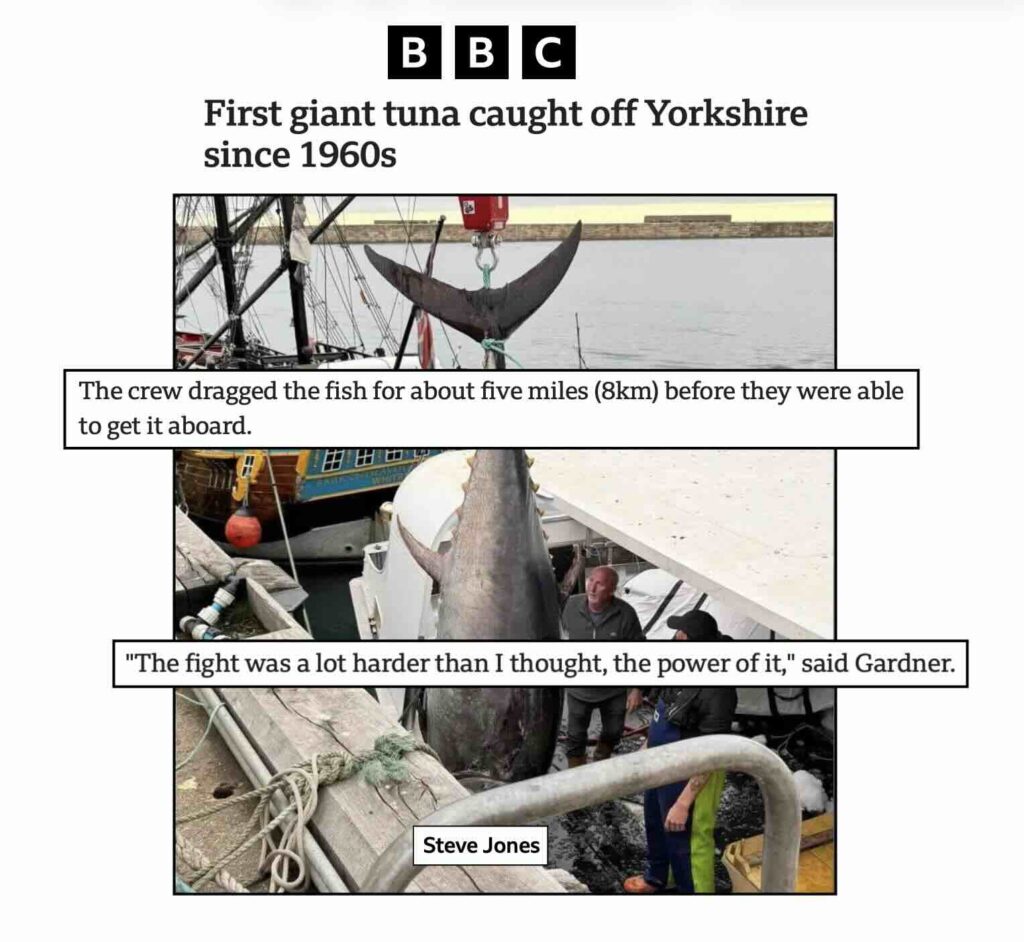
In its story, “First giant tuna caught off Yorkshire since 1960s,” the BBC reports that a commercial fishing crew caught a 338-kilogram (745-pound) bluefin tuna about 10 miles off the coast and caught another the following day. Crew member Jack Gardner described catching the first tuna as the “best feeling ever.”
What makes the framing particularly troubling is that the BBC itself explains why these magnificent animals disappeared from the region in the first place: overfishing and the depletion of the herring on whom they feed. Researchers say their return is evidence that conservation measures and fisheries management have allowed bluefin populations and the North Sea ecosystem to recover.
In other words, humans helped drive bluefin tuna out of these waters by catching too many of them. Six decades later, they finally return — and catching them becomes part of the celebration.
The tuna’s experience is missing from the story
The BBC describes the dramatic struggle between the fishermen and the tuna, but the story is told entirely from the fishermen’s perspective.
Gardner recounts the excitement of seeing the enormous fish jump from the water and the difficulty of reeling the animal in. Other accounts of the catch report that the struggle dragged on for miles before the tuna was finally brought aboard.
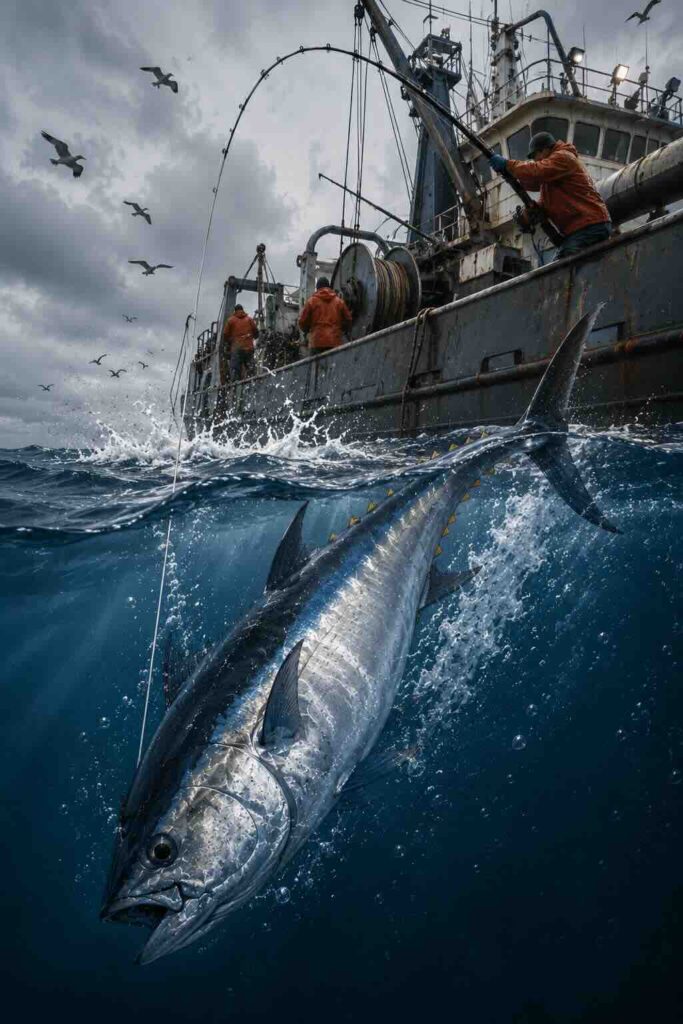
But what did that “fight” mean for the tuna? The BBC doesn’t ask. The fear, exhaustion, injury and suffering the animal experienced while struggling to escape are omitted from the story. Nor does it acknowledge the obvious reason the tuna fought so hard: the animal was trying to survive. Instead, the struggle is presented as an exciting contest between fisherman and fish.
That framing is common in fishing coverage. The human experience — the thrill of the chase, the difficulty of landing the animal and the size and value of the catch — becomes the story. The experience of the animal on the other end of the line effectively disappears.
A 745-pound animal becomes an “it”
The BBC’s language further distances readers from the animal at the center of the story,. The reporter repeatedly refers to the tuna as “it,” rather than “he,” “she” or “who.” This convention is deeply ingrained in journalism, particularly when reporters write about animals used for food, but it reinforces the idea that the animal is an object rather than a living individual.
That distinction matters. A bluefin tuna is not merely a 338-kilogram “specimen,” a valuable commodity or an exciting catch. Tuna are living animals capable of responding to threats and struggling to escape them.
Yet once the fish is caught, the coverage quickly shifts toward human interests: the achievement of the fishermen and the significance of the catch.
The individual animal — whose return supposedly represents a conservation success — becomes almost incidental.
Conservation for whom?
Scientists say the return of Atlantic bluefin tuna reflects, at least in part, decades of fisheries management and conservation efforts. University of Hull researchers describe their reappearance as evidence that international measures limiting tuna catches have helped populations recover.
But the BBC’s framing raises a larger question that mainstream wildlife coverage rarely asks: Is the goal of conservation to protect wild animals and restore ecosystems, or to restore populations so humans can resume catching and killing them? Those goals are necessarily the same.
The return of bluefin tuna to the North Sea could have been an opportunity for the BBC to explore the animals themselves — their remarkable migrations, their role as apex predators, the threats that caused them to disappear and what their return means for the marine ecosystem. Instead, the capture of one of these newly returned animals becomes the centerpiece of the story.
The animals deserve a place in the coverage
Balanced journalism doesn’t require journalists to ignore the perspectives of fishermen, but it does it does require them to recognize that another perspective exists.
When an animal struggles for miles against a fishing line, the story shouldn’t examine that struggle exclusively through the eyes of the person holding the rod. And when a species returns after being driven from an ecosystem partly by overfishing, journalists should at least acknowledge the contradiction inherent in celebrating its recovery by celebrating its capture.
The return of Atlantic bluefin tuna to the North Sea is extraordinary news. Their return should be celebrated for their sake, too — not simply as another opportunity to catch them.