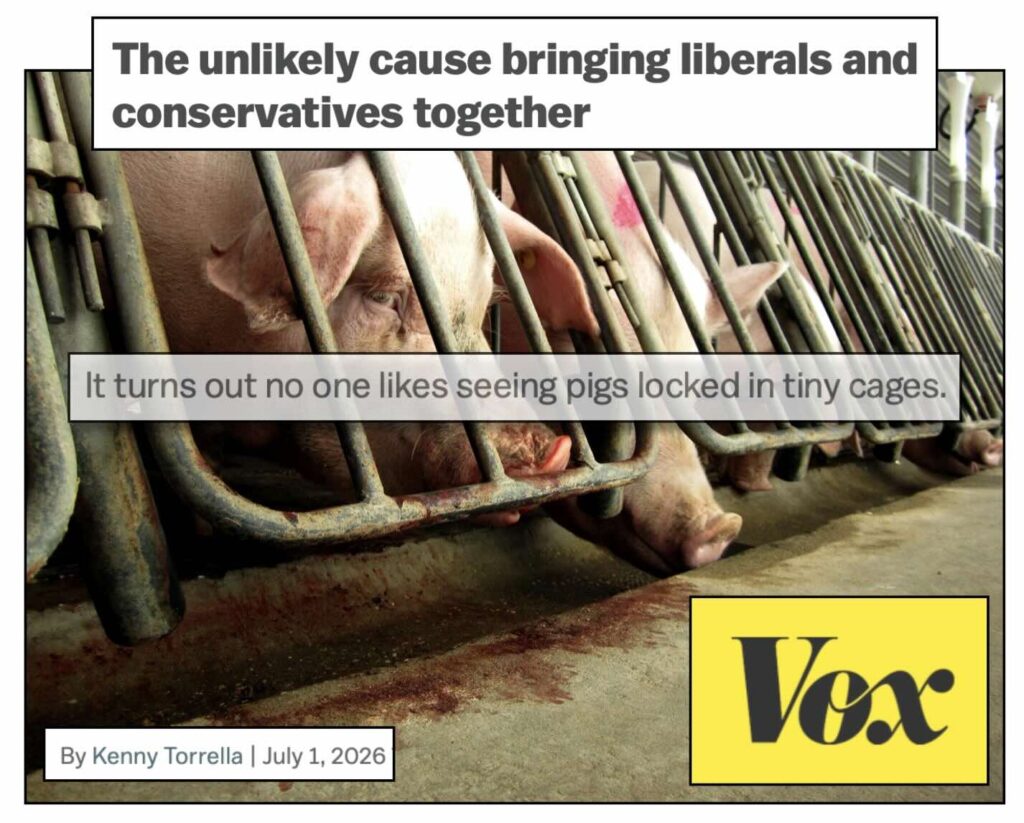
In a political climate where Americans seem divided on almost everything, Vox is highlighting an issue that is bringing liberals and conservatives together: opposition to one of the pork industry’s cruelest practices.
In a recent Future Perfect article, “The unlikely cause bringing liberals and conservatives together,” reporter Kenny Torrella examines the growing bipartisan backlash against gestation crates, metal cages used to confine pregnant pigs so tightly that they cannot even turn around. Millions of pigs in the United States are confined in these crates at any given time.
What makes the article particularly noteworthy is that Vox doesn’t sanitize the reality of factory farming or allow pork industry propaganda to obscure what is happening to the animals. Instead, Torrella puts the pigs — and their suffering — at the center of the story.
Cruelty Isn’t a Partisan Issue
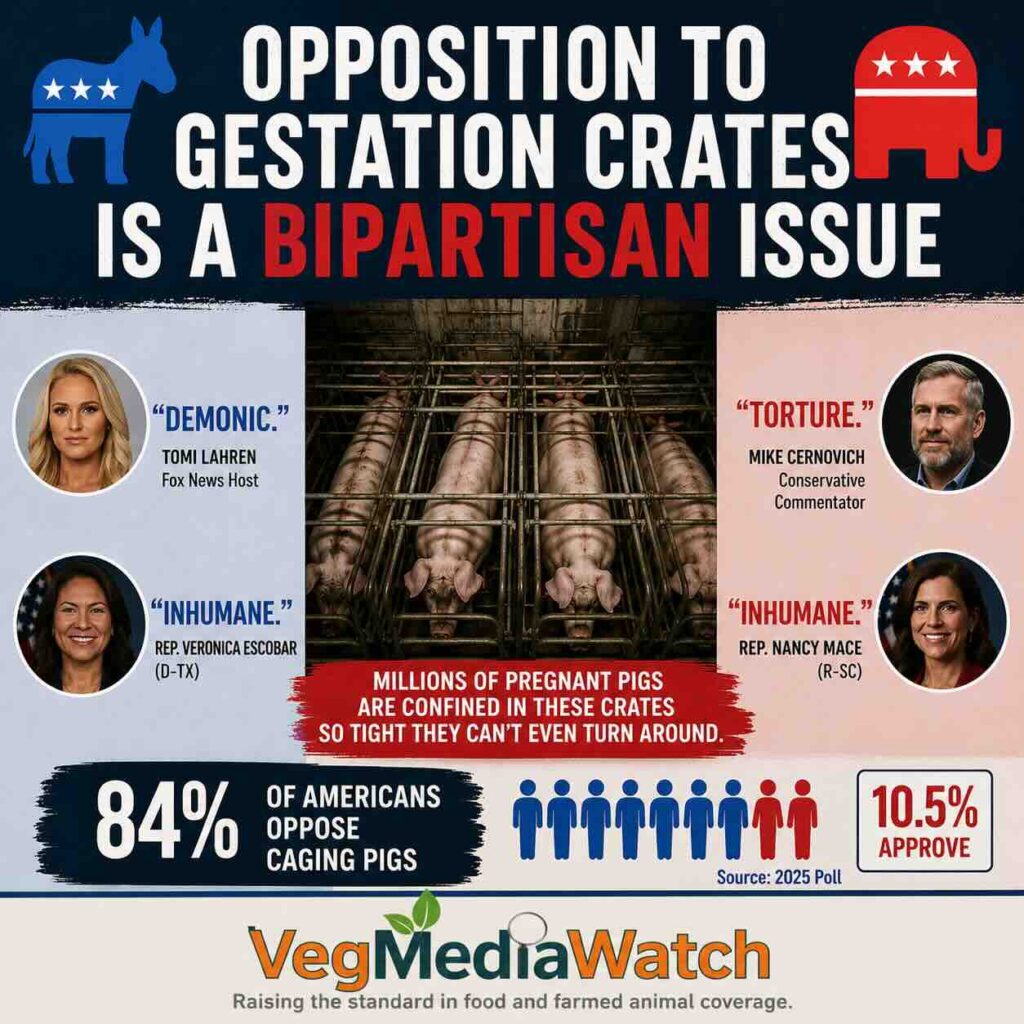
Vox opens the article with a striking collection of reactions to gestation crates: “demonic,” “abusive,” “torture,” and “inhumane.” The surprise is that those condemnations come from people across the political spectrum, including conservative commentator Mike Cernovich, Fox News host Tomi Lahren and Republican Rep. Nancy Mace and Democratic Rep. Veronica Escobar.
That framing matters.
Animal welfare is often portrayed in the media as a progressive or liberal cause. Vox challenges that assumption by documenting something that should be intuitive: people don’t need to share the same political ideology to recognize and denounce animal cruelty.
The polling reinforces that point. Torrella cites a 2025 survey finding that 84% of Americans oppose caging pigs, compared with just 10.5% who approve of the practice. The article also notes that Democrats are only slightly more likely than Republicans to oppose factory farming practices overall.
In other words, the political divide over animal welfare may be much smaller than conventional media narratives suggest.
Vox Exposes What the Pork Industry Would Rather Keep Out of Sight
The article also provides important context about the political battle now unfolding in Congress.
The so-called Save Our Bacon Act, included in the House version of the Farm Bill, would override animal welfare laws approved by voters in California and Massachusetts and prevent similar restrictions in the future. Those laws don’t merely prohibit gestation crates within their states; they also restrict the sale of pork produced using the cages elsewhere.
Vox explains how pork industry groups, led by the National Pork Producers Council, have fought those laws through lawsuits and legislation. But Torrella also makes an especially revealing observation: while the trade group has promoted the Save Our Bacon Act extensively, its social media feed does not show people what gestation crates actually look like. That’s significant because images of the crates contradict the industry’s rhetoric.
As Josh Balk of the Accountability Board tells Vox, when members of Congress are shown what a gestation crate actually is, their shock is unmistakable. The cruelty is so apparent, he argues, that political affiliation becomes almost irrelevant.
That is precisely why responsible journalism about factory farming matters. Consumers hear constantly about bacon prices, farmers, production costs and industry economics. Far less often are they shown the animals whose bodies make those products possible — or the conditions in which those animals are forced to live.
Going Beyond the Industry Narrative
Torrella also avoids presenting the debate as a simplistic conflict between animal advocates and farmers.
Vox reports that some pork farmers never used gestation crates because they considered them cruel, while others have transitioned away from the cages and want the industry to move beyond the fight. The article also explores conservative opposition to the Save Our Bacon Act based on states’ rights and respect for voters who approved animal welfare laws.
That context makes the reporting stronger. Rather than reflexively treating the industry’s largest lobbying organization as synonymous with farmers themselves, Vox shows that there are divisions within the pork industry — just as there are divisions within political parties.
The result is a more complete picture of the debate.
This Is the Kind of Animal Agriculture Reporting We Need
At VegMediaWatch, we frequently call attention to news coverage about meat that leaves the animals almost entirely out of the story. Economic considerations are treated as newsworthy; animal suffering is often treated as peripheral.
Vox demonstrates that journalism doesn’t have to make that choice.
Torrella covers the politics, economics, industry lobbying and legislative battle while still clearly explaining what is at stake for the animals: pregnant pigs immobilized inside cages so restrictive that they cannot turn around.
And perhaps the article’s most encouraging message is that opposition to such cruelty doesn’t belong to one political party.
As Liam Gray of the conservative and libertarian Wilberforce Institute tells Vox, the emerging divide over animal protection may increasingly be less about left versus right and more about the public versus powerful special interests.
By documenting that shift — and by refusing to hide the animals behind industry euphemisms — Vox is providing the kind of clear-eyed coverage that farmed animals desperately need.
VegMediaWatch thanks Vox and Kenny Torrella for shining a spotlight on the cruelty of gestation crates and for showing readers that compassion for animals can transcend political divisions.